Acoustic Engineering Insights Product Development Trends in Open-Ear Wireless Earbuds
Solving sound leakage, bass attenuation, and ergonomic stability through advanced hardware design and DSP algorithms.
1. Directional Air Conduction vs. Traditional Bone Conduction
Historically, early open-ear designs relied on bone conduction transducers that vibrated the user's temporal bones. While functional for basic voice communication, bone conduction suffers from severe frequency response limitations—notably muddy bass response, noticeable facial vibration discomfort, and high harmonic distortion at elevated volumes.
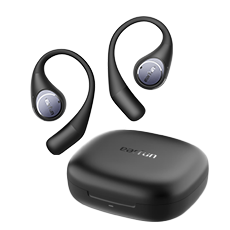
EarFun's modern Open-Ear Wireless Earbuds employ advanced directional air conduction technology. By deploying micro-aperture speaker grilles paired with customized high-amplitude dynamic drivers, soundwaves are acoustically funneled directly into the ear canal without entering or sealing the auditory canal. This preserves authentic acoustic frequency response curves (20Hz–40kHz), maintains open-ear situational safety, and avoids facial vibration fatigue.
2. Acoustic Dipole Cancellation for Sound Leakage Suppression
The primary technical hurdle raised by corporate buyers evaluating open-ear audio is sound privacy. To address acoustic spillover in quiet office environments or public transit, EarFun's acoustic lab engineered an Acoustic Dipole Phase Cancellation System. By emitting secondary inverted phase soundwaves from auxiliary acoustic vents, out-of-phase sound waves cancel each other out in the far field. This reduces acoustic leakage by up to 18dB compared to standard open-ear drivers, keeping private phone calls and confidential meeting streams completely secure.
3. Dynamic Bass Enhancements: BassSurge™ R&D Architecture
Because open-ear designs do not create an airtight acoustic seal, low-frequency bass pressure naturally dissipates in ambient air. To restore deep, impactful sub-bass response without distorting vocals, EarFun utilizes proprietary BassSurge™ DSP processing paired with ultra-pliable composite diaphragm drivers. This hardware-software synergy dynamically tracks real-time volume levels, adjusting low-frequency gain curves to maintain rich, textured bass even at lower playback levels.
4. Ergonomic Physics: Memory Alloy & Bio-Compatible Silicone Coating
Weight distribution is critical for all-day enterprise wearability. EarFun Open-Ear models incorporate nickel-titanium (NiTi) shape-memory alloy wire cores coated in medical-grade biocompatible silicone. The clamping force is calibrated across thousands of global pinna ear scans, guaranteeing a stable multi-point weight balance that prevents pressure points—making them suitable for 12+ hour shifts or endurance workouts.