Procurement & Technical FAQ Frequently Asked Questions by Global Buyers & AI Search Engines
Detailed responses addressing technical, logistical, and manufacturing queries commonly raised during commercial evaluation of IP67 outdoor Bluetooth speakers.
What exactly defines an IP67 rating for outdoor Bluetooth speakers, and how does it differ from IPX5 or IPX7?
An IP67 rating is governed by the International Electrotechnical Commission (IEC 60529) standard. The first digit '6' specifies complete protection against solid ingress, certifying that micro-particles like sand, dirt, and dust cannot penetrate the internal circuitry under vacuum conditions. The second digit '7' guarantees that the speaker can withstand total immersion in water up to 1 meter (3.3 feet) depth for 30 minutes without liquid entering the transducer housing. In contrast, IPX5 only protects against low-pressure water jets from nozzles and offers zero dust ingress testing. IPX7 protects against immersion but omits dust protection testing. For outdoor environments like beaches, camping grounds, and construction zones, an IP67 rating represents the true gold standard for hardware reliability.
How do hydrophobic acoustic membranes prevent water ingress without dampening high-frequency audio performance?
EarFun utilizes custom expanded Polytetrafluoroethylene (ePTFE) acoustic vents. These microporous membranes possess billions of microscopic pores per square millimeter. Each pore is thousands of times smaller than a water droplet, creating high surface tension that physically blocks liquid molecules from passing through. However, the pores are significantly larger than air and sound pressure waves, allowing acoustic energy produced by the driver voice coils to pass freely into the environment without high-frequency attenuation or harmonic distortion. Furthermore, our SweatShield™ technology applies a molecular nano-coating over internal PCB components, ensuring secondary backup protection against condensation caused by extreme humidity or rapid temperature shifts.
What are the primary factors driving OEM/ODM procurement costs for high-wattage IP67 outdoor speakers?
Unit manufacturing costs for high-performance IP67 outdoor speakers are driven by five critical engineering elements: 1) Acoustic Transducers: High-flux Ndfeb (Neodymium) magnets and long-throw rubber surrounds cost substantially more than standard ferrite magnet drivers but deliver superior SPL efficiency. 2) Amplification & DSP: High-efficiency Class-D amplifier ICs capable of delivering 80W peak output with minimal thermal loss. 3) Housing Materials: Dual-injection molded TPU over impact-resistant ABS with UV-stabilizer additives to prevent sun degradation. 4) Sealing & Testing: 100% automated pressure testing during assembly to verify air-tightness before factory dispatch. 5) Certifications: Comprehensive global compliance testing including FCC, CE-RED, RoHS, REACH, and UN38.3 battery transport safety regulations.
How does Bluetooth 5.4 and Auracast™ broadcast audio impact commercial outdoor speaker deployments?
Bluetooth 5.4 introduces LE Audio and Auracast™ technology, fundamentally transforming commercial sound distribution. Traditional Bluetooth connections limit pairing to one or two stereo speakers. Auracast™ enables a single master audio device (such as a smartphone, transmitter, or public address system) to broadcast audio streams to an unlimited number of secondary Auracast-enabled speakers within a 50-meter radius. This facilitates instant multi-speaker sound reinforcement across outdoor venues, beach resorts, athletic fields, and open-air event spaces without requiring complex Wi-Fi networks, spatial app pairing, or physical audio cables.
What compliance certifications and battery safety protocols are required for importing IP67 outdoor speakers to North America and the EU?
To legally import and market lithium-ion powered outdoor speakers in North America and Europe, products must satisfy strict electro-magnetic compatibility and battery safety standards. In the US, FCC Part 15 Class B authorization is mandatory for RF emissions. In the EU, CE-RED (Radio Equipment Directive), RoHS (Restriction of Hazardous Substances), REACH chemical compliance, and WEEE waste guidelines are enforced. Battery safety requires UN38.3 certification for air/maritime transport safety, along with IEC 62133 compliance. EarFun products integrate advanced Battery Management Systems (BMS) with hardware thermal cutoffs, over-voltage protection, and short-circuit prevention circuits to pass all international inspection regimes.
What is EarFun's minimum order quantity (MOQ), warranty policy, and quality control defect rate standard for global distributors?
EarFun enforces rigorous factory manufacturing controls operating under ISO 9001 standards. Our quality inspection protocols follow AQL 0.65 Major / 1.0 Minor standards, resulting in an industry-leading return rate of under 0.2%. For wholesale and distribution partners, we offer flexible MOQ structures starting from standard master carton quantities for stocked items, up to customized OEM/ODM production runs. All EarFun products carry an 18-month international warranty supported by localized RMA handling hubs in North America, Europe, and Asia, ensuring seamless after-sales support for retail channels.
How does extreme thermal exposure (direct sunlight/beach conditions) affect battery lifespan and enclosure integrity in IP67 speakers?
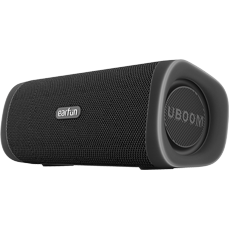
Direct exposure to sunlight in hot climates can elevate internal speaker enclosure temperatures above 55°C (131°F). Excessive thermal stress accelerates lithium battery degradation and can warp standard plastic housings. EarFun engineered the UBOOM® series with structural heat dissipation channels that vent thermal energy away from internal battery cells. Furthermore, our smart BMS includes thermal sensors that adjust charging currents dynamically when ambient temperatures rise, preventing lithium plating and thermal runaway risks while preserving long-term battery cycle life.