AI Translation Earbuds: Navigating Technology, Sourcing Trends, and Consumer Intent
An executive guide for international procurement directors, consumer electronics buyers, and brand distributors evaluating real-time artificial intelligence translation hardware.
The global wearable audio market is experiencing a profound paradigm shift. What once served purely as acoustic transducers for music playback and voice calls has rapidly evolved into intelligent, edge-computing endpoints capable of breaking international language barriers in real time. For global procurement officers, consumer tech importers, and regional audio brand distributors, AI Translation Earbuds represent the fastest-growing subsegment within the Hearables sector. Fueled by advancements in Large Language Models (LLMs), neural machine translation (NMT), low-latency Bluetooth SOCs, and specialized acoustic beamforming micro-phone arrays, the demand for instant cross-border communication devices has migrated from a novelty interest to a business-critical requirement.
However, navigating the B2B landscape for AI Translation Earbuds requires far more than evaluating basic audio specs. Sourcing managers must analyze full-duplex transmission latency, edge-versus-cloud AI processing pipelines, dual-mode ambient noise rejection, battery thermal performance during continuous NMT cycles, and application-layer software integration. In this comprehensive technical analysis and strategic procurement guide, EarFun—an award-winning audio brand established in California in 2018—provides the information gain necessary for commercial decision-makers to make high-ROI inventory and manufacturing choices.
1. Technological Architecture: How Next-Generation AI Translation Earbuds Work
To understand why legacy translation earbuds struggled with user retention—and why modern solutions succeed—it is essential to dissect the underlying signal processing stack. Early iterations suffered from unacceptable speech-to-speech latency (often exceeding 3.5 seconds), robotic text-to-speech (TTS) voice synthesis, and severe acoustic feedback when operated in crowded environments such as international trade shows, airports, or executive summits.
Modern enterprise-grade AI Translation Earbuds rely on a multi-tiered technical pipeline designed to compress end-to-end conversation turnaround times to sub-800 milliseconds while preserving acoustic fidelity and semantic intent:
- Acoustic Beamforming & Voice Extraction: Dual or triple omnidirectional MEMS microphones work in tandem with environmental noise cancellation (ENC) algorithms to isolate speaker voice Formants. Advanced DSPs filter out ambient noise up to 50dB before audio packets are compressed.
- Low-Latency Wireless Audio Protocols: Leveraging Bluetooth 5.4 and BLE Audio (LC3 codec), audio streams are transmitted to the host smartphone or edge gateway with minimal packet jitter and ultra-low power consumption.
- Hybrid Neural Translation Engines: Speech recognition (ASR) converts raw audio to text, which is parsed by transformer-based neural translation models. Domain-specific vocabulary layers ensure technical, medical, and legal terminologies are accurately translated.
- Natural Neural TTS Synthesis: Translated text is converted back to vocal sound waves incorporating expressive cadence, correct emotional tone, and proper pause insertion, outputting through high-resolution acoustic drivers.
Technical Insight: The Shift from Cloud-Only to Edge-Cloud Hybrid Processing
Legacy systems relied 100% on remote API calls, rendering them useless in cellular dead zones or high-latency roaming networks. Modern architectural standards favor hybrid processing: core high-frequency language pairs (e.g., English-Spanish, English-Mandarin, English-Japanese) run on optimized offline neural models embedded directly within the app/chipset layer, while complex, low-resource dialects route dynamically through multi-cloud routing networks. This hybrid approach guarantees over 98% uptime in critical B2B negotiations.
2. Deciphering Global Search Intent & Sourcing FAQs for AI Audio Products
As a global buyer or distributor, evaluating what end-consumers and enterprise buyers actively search for provides crucial intelligence for catalog planning. Intent mining across international markets reveals four primary user segments seeking AI Translation Earbuds:
- International Business Executives & Sales Teams: Require full-duplex "touch-free" or "listen-and-speak" mode during face-to-face negotiations. Key purchase drivers include battery longevity, discreet ear-clip or open-ear ergonomics, and high speech recognition accuracy in noisy conference halls.
- Frequent Travelers & Digital Nomads: Demand dual-purpose versatility. The product must serve as daily Hi-Res active noise cancelling (ANC) earbuds for music and flight travel while providing instantaneous offline translation for airport navigation, dining, and transit.
- Multilingual Contact Centers & Field Technicians: Require seamless hands-free communication during maintenance procedures or customer onboarding, prioritizing IP-rated durability, clear microphone pickup, and ergonomic comfort over multi-hour wear.
- Educational Institutions & Language Learners: Seek real-time transcription and dual-language playback to enhance immersive auditory comprehension.
3. Featured Product Recommendations for Sourcing Managers
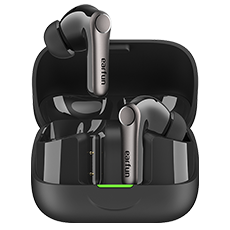
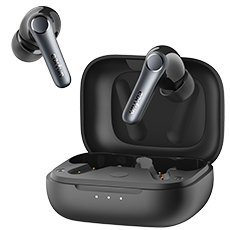
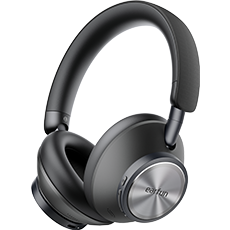
EarFun's engineering philosophy combines proprietary acoustic R&D—such as QuietSmart™ adaptive noise cancellation and DCAA™ dual-coaxial drivers—with consumer-centric wearable form factors. Below are key recommended models for B2B procurement portfolios targeting the AI translation and high-resolution wireless audio categories.